Procurement for Housing
2 Olympic Way, Woolston Grange Avenue
Birchwood, Warrington, WA2 0YL
Access goods, works and services to support your net zero housing ambitions from fabric upgrades to low-carbon technologies and whole-house retrofit via a compliant DPS for social housing landlords across the UK.
Our Asset Decarbonisation and Retrofit Dynamic Purchasing System (DPS) provides housing associations, councils, ALMOs and public-sector landlords with a compliant route to deliver net zero housing. It covers services such as PAS 2035 assessments, fabric-first upgrades, low-carbon technology installation, whole-house retrofit, district-wide systems and supply of net zero materials. With national and regional coverage, it enables you to access a broad supplier base, and integrate innovation and training into your delivery. The Asset decarbonisation and retrofit DPS structure means new suppliers can join at any time helping drive innovation and maintain competition and capacity for your net-zero works.
Decarbonisation projects can stall due to limited capacity, inconsistent standards, or ineffective technology. By providing access to a vetted, flexible supplier base and supporting innovation, our DPS helps landlords complete net-zero works at scale, creating healthier, more resilient communities while reducing environmental impact.


Review the list of suppliers available on this dps. See lots section below for suppliers per lot.

No suppliers found.

See buyers guide for more information
Provides full support for compliance with PAS 2035 / retrofit standards and related retrofit consultancy. This includes services such as retrofit design, assessments, coordination, ventilation surveys, inspections, project management, building services consultancy, energy-efficiency advice, structural / mechanical / electrical engineering, environmental consulting, testing, and other technical services.
Offers expert advisory and strategy work to enable organisations to achieve net zero outcomes. Typical services include architectural, engineering and planning consultancy; energy performance and management; environmental / sustainability advice; construction oversight; project management; and quantity surveying.
Covers supply and installation of building fabric and passive measures such as internal & external wall insulation, loft and underfloor insulation, windows & doors, ventilation systems, smart controls, draft proofing, cladding, internal partitioning, and related building alteration works.
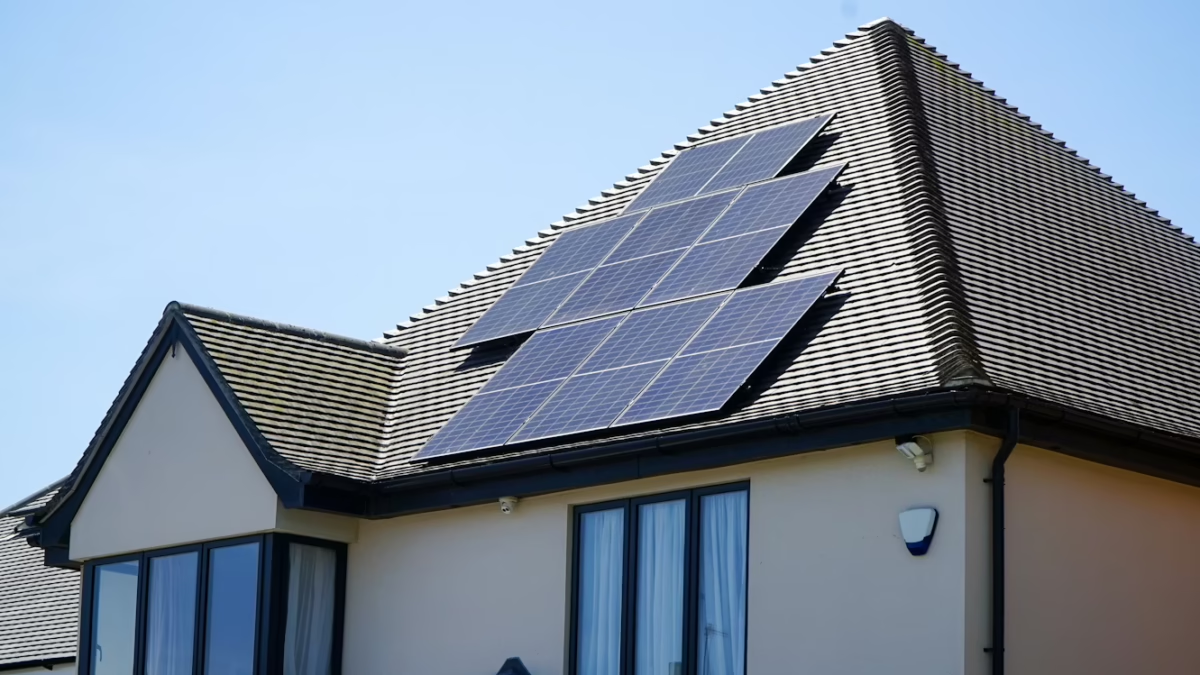
Focused on the deployment, commissioning and ongoing maintenance of technologies that enable decarbonisation. This will include HVAC systems, heating systems, mechanical and electrical installations, renewable generation (e.g. solar), district heating, network infrastructure, decommissioning, and plumbing / mechanical services.
A turnkey retrofit package delivering comprehensive retrofit across entire dwellings or properties. This integrates both fabric-first and technology solutions, insulation, HVAC, renewables, electrical works, plumbing, decommissioning and other retrofit measures, under a single delivery plan.
Design, development and operation of district-level energy systems (heating, cooling, heat recovery) and associated infrastructure works. Services can include concept design, construction of district heating plants, network design, plumbing / ventilation, electrical engineering, consultant support, operations, maintenance, and training.
Provision of certified materials, components and products for retrofit and decarbonisation work. Examples: insulation, cladding, heat pumps, windows & doors, HVAC components, control systems, boilers, radiators, ventilation equipment, storage heaters, etc.
Offers software, digital tools and systems that support net zero delivery. This includes BIM modelling, asset / performance data tools, compliance systems, IT / software development, document and workflow management tools, analytics, and integration services.
Training and skills development services aimed at suppliers, contractors and internal teams. This includes courses in environmental and retrofit best practice, health & safety, technical modules (e.g. insulation, ventilation, systems operations), compliance training, upskilling, and benchmarking / competence frameworks.
Our straightforward process enables you to run Mini-Competitions to find the right supplier for your needs. You can award contracts for any duration that suits your project requirements. Further information on the Mini-Competition process can be found below.
Mini-Competition Process
Our Mini-Competition process allows you to specify your exact project requirements. Please contact us to start the process. All suppliers on the relevant lot of the DPS who have the necessary capabilities are invited to submit tenders. The process typically takes 2–4 weeks from invitation to award.
Selection criteria:
Suppliers are evaluated on their ability to deliver your project based on:
Our support doesn't stop at contract award. We provide a comprehensive wraparound service throughout your entire procurement journey from evaluation and award through to contract management and delivery. We work alongside you to ensure suppliers are held to account, performance is monitored, and your contract delivers the outcomes you need. Our goal is simple: to help you achieve the best possible results for the residents and communities we serve, with expert guidance at every stage.
Need to catch up with your account manager? Or want to discuss a project you are working on, our team will be happy to talk this through with you.
Commercial Manager South and NI
Commercial Manager North & Midlands
Account Manager North
Account Manager Midlands
Account Executive South
Account Manager South & SW
Account Manager South & SE
Account Executive North & Midlands
Commercial Manager Scotland
Account Manager Scotland
Account Manager Wales
Sorry, we couldn’t find any team members that match your current filters.
Balancing tight budgets, regulatory compliance, and resident expectations requires suppliers who truly deliver. Our DPS connects you with vetted contractors while our team supports you from specification, ongoing managament all the way through to completion helping you avoid costly variations, delays, and the administrative burden of running multiple procurements. Contact us to streamline your approach.
Scrutiny over spending, pressure to demonstrate social value, and the challenge of coordinating works across multiple sites and teams can slow down essential projects. Our DPS simplifies procurement while our experts guide will be on hand throughout to you through evaluation, contract management, and performance monitoring ensuring you meet your obligations without the overhead. Get in touch to discuss your needs.
Juggling responsive repairs, cyclical programmes, and major works means procurement can quickly become a bottleneck when you need to focus on residents. Our DPS gives you a streamlined route to qualified contractors for your specific requirements, with our team supporting you through evaluation and ongoing contract management reducing administrative burden so you can prioritise service delivery. Speak to us today.
The Asset Decarbonisation & Retrofit DPS provides access to emerging net zero housing technologies as new suppliers join the DPS throughout its lifetime. This flexibility ensures organisations can access latest innovations rather than being limited to pre-selected technologies on a static framework. Emerging technologies may include advanced heat pump systems with improved performance in cold climates. Enhanced thermal storage systems enabling better energy time-shifting. Integrated renewable energy systems combining solar PV, battery storage, and heat pump technologies. Advanced ventilation systems with heat recovery achieving near-zero energy loss. Innovative insulation materials with improved thermal and environmental performance. Smart control systems using AI and machine learning to optimise building performance. Hydrogen systems potentially offering alternative heating solutions. Advanced district heating systems integrating renewable heat sources at scale. Innovative materials and construction techniques reducing embodied carbon. Digital monitoring and optimisation platforms improving real-time performance. By offering flexibility for new suppliers to join throughout the DPS lifetime, organisations benefit from access to emerging technologies supporting continuous net zero housing improvement and innovation.
Organisations integrate multiple net zero technologies through comprehensive planning, design, and procurement to create effective net zero housing solutions addressing all building systems and envelope. Initial assessment identifies building characteristics, occupancy patterns, climate zone, and performance targets. Energy modelling predicts performance of different technology combinations, optimising selection. Design services coordinate technology selection ensuring systems work together effectively. Building fabric improvements form the foundation, reducing heating and cooling demand before introducing renewable technologies. Heating system selection (heat pumps, biomass, or district heating) addresses thermal comfort. Renewable electricity (solar PV or wind) reduces grid electricity demand. Ventilation systems ensure air quality whilst minimising energy loss. Control systems optimise operation across multiple technologies. Storage systems (batteries for electricity or thermal storage for heat) maximise self-consumption of renewable energy. Integration prioritises whole-house approaches addressing all systems simultaneously rather than piecemeal upgrades. Performance monitoring tracks actual outcomes, identifying optimisation opportunities. The DPS includes contractors experienced in integrating multiple technologies into effective net zero housing solutions. This coordinated approach maximises performance, cost-effectiveness, and sustainability compared to ad-hoc technology selection.
Retrofit training services through the Asset Decarbonisation & Retrofit DPS provide upskilling and professional development supporting net zero housing delivery. Services include environmental training covering sustainability principles and best practice. Safety training addressing hazards specific to retrofit work including working at height, asbestos management, and electrical safety. Industrial and technical training developing practical skills in retrofit installation, inspection, and certification. Education and training services providing formal qualifications and certifications. Training programme services developing customised training addressing specific organisational needs. Personnel training services upskilling staff in specific technical areas. Specialist training services providing advanced training in complex areas such as heat pump installation, solar PV commissioning, or district heating operation. Training seminars providing knowledge updates on emerging technologies and regulatory changes. Benchmarking competence services assessing workforce capability and identifying training needs. Workforce development services supporting career progression and skill development. Compliance and quality assurance training ensuring staff understand quality requirements and compliance obligations. By investing in retrofit training through the DPS, organisations build internal capability, reduce dependency on external expertise, and create career progression opportunities attracting and retaining skilled staff. Training supports successful project delivery and ongoing asset management post-retrofit.
Net zero materials supply through the Asset Decarbonisation & Retrofit DPS provides provision of approved materials for decarbonisation and retrofit works ensuring quality, compliance, and cost-effectiveness. Materials include solar panels and associated electrical equipment for renewable electricity generation. Cladding materials for external wall insulation and aesthetic upgrades. Insulation materials including rigid foam, mineral wool, and natural insulation products. Heat pumps providing air source and ground source heating solutions. Electric boilers providing zero-carbon heating alternatives. Radiators, thermostatic radiator valves, and heating system components. HVAC (heating, ventilation, and air conditioning) equipment. Windows and doors providing improved thermal performance. Storage heaters providing electric heating solutions. Immersion heaters and water cylinders for hot water provision. Ventilation systems ensuring air quality post-retrofit. Solid fuels for biomass systems. General building materials supporting retrofit works. Supply services ensure materials meet quality standards, comply with relevant regulations and standards, are cost-competitive, and are delivered reliably. Material supply partners can advise on material selection optimising performance, cost-effectiveness, and sustainability. By accessing materials through the DPS, organisations benefit from established supplier relationships and tested product specifications improving retrofit quality and cost-certainty.
Digital solutions through the Asset Decarbonisation & Retrofit DPS support net zero housing delivery through technology enabling design, monitoring, and performance optimisation. Services include BIM (Building Information Modelling) enabling 3D design and clash detection prior to construction, reducing on-site issues and rework. Performance measurement tools track building performance post-retrofit, identifying whether retrofit measures are delivering expected energy savings and comfort improvements. Data aggregation systems consolidate performance data from multiple properties enabling portfolio-level analysis and benchmarking. Asset tagging systems organise and track building components and systems facilitating maintenance and future upgrades. Software for compliance and document management helps organisations track regulatory compliance and maintain audit-ready documentation. Productivity software streamlines project management and team collaboration. IT development and consultancy services provide custom solutions addressing specific organisational needs. Training and network software services enable remote training and knowledge sharing. These digital solutions improve net zero housing project planning, delivery, performance tracking, and ongoing optimisation. Digital monitoring post-retrofit provides evidence of performance, supporting funding compliance reporting and enabling performance optimisation through operational adjustments.
Organisations use design services through the Asset Decarbonisation & Retrofit DPS to develop tailored net zero housing solutions addressing their specific circumstances, constraints, and objectives. Initial design services assess existing properties or new developments, evaluating retrofit feasibility, identifying improvement opportunities, and recommending appropriate solutions. Architectural design services develop aesthetic and functional retrofit interventions respecting property character whilst achieving performance targets. Structural design ensures retrofit works maintain or improve structural integrity. Mechanical and electrical design addresses heating, ventilation, cooling, and electrical system upgrades. Environmental design optimises passive performance through orientation, glazing, thermal mass, and ventilation strategies. Cost design balances performance ambitions against budget constraints, identifying cost-effective solutions. Funding design aligns proposals with funding criteria, maximising funding competitiveness. Integrated design coordinates all disciplines ensuring systems work together effectively for optimal net zero housing outcomes. Design services also include quality assurance and commissioning ensuring completed works meet design specifications and perform as intended. By engaging design services early, organisations develop effective net zero housing solutions maximising performance, cost-effectiveness, and funding success.
Net zero consultancy services through the Asset Decarbonisation & Retrofit DPS provide expert advice on net zero housing strategy and implementation across all aspects of decarbonisation projects. Services include asset management consultancy assessing property portfolios and developing retrofit strategies. Architectural consultancy providing design services for retrofit interventions. Engineering consultancy addressing structural, mechanical, electrical, and civil engineering aspects. Planning services navigating planning permissions and building regulations compliance. Construction management services coordinating project delivery. Energy management consultancy optimising building performance post-retrofit. Environmental consultancy assessing sustainability impacts. Net zero strategy and advisory services developing organisational decarbonisation roadmaps. Project management services coordinating complex net zero housing programmes. Quantity surveying services estimating project costs accurately. Building consultancy services providing independent technical assessment. These consultancy services enable organisations to develop robust net zero housing strategies, navigate complexity, and achieve successful project delivery. Consultants experienced in funding applications can strengthen Warm Homes: Social Housing Fund (WH:SHF) or ECO funding bids, improving success rates. For organisations new to net zero housing, comprehensive consultancy support de-risks projects and accelerates learning.
Organisations consider district heating for net zero housing when serving multiple properties, new developments, or communities where centralised heating is more efficient than individual building systems. District heating enables economies of scale in renewable heat generation, reducing per-property costs compared to individual heat pump installations. Single large-scale renewable heat source (such as biomass or solar thermal) serving multiple properties is often more cost-effective than multiple smaller systems. District heating reduces individual property complexity and installation disruption compared to whole-house retrofit approaches. Heat distribution networks can utilise waste heat sources (such as from industrial processes or data centres) improving overall efficiency. District heating supports net zero housing objectives by enabling low-carbon or zero-carbon heat provision at scale. For new developments or substantial regeneration projects, district heating infrastructure can be designed into the project from inception, optimising efficiency and cost-effectiveness. The DPS includes contractors experienced in feasibility assessment, design, installation, and operation of district heating systems enabling organisations to explore net zero housing solutions at scale.
District heating and infrastructure services through the DPS provide design and delivery of district-level net zero housing systems serving multiple properties or communities. Services include district heating plant construction, design, and operation enabling efficient heat distribution. District heating and cooling systems provide renewable heating and cooling at scale. Biomass systems provide renewable energy from sustainable biomass sources. Solar thermal systems capture solar heat for district heating. Heat recovery systems capture waste heat for reuse. Associated services include heating system design optimising district heating configurations, plumbing consultancy addressing fluid distribution, ventilation consultancy ensuring appropriate air quality, construction economics services optimising cost-effectiveness, and electrical engineering supporting system integration. Services encompass concept development identifying district heating feasibility, design engineering defining technical specifications, project delivery coordinating construction and installation, operations support establishing ongoing management processes, maintenance services ensuring long-term system performance, and training enabling staff to operate and manage district heating systems effectively. District heating infrastructure enables organisations to deliver net zero housing solutions at community scale, providing efficient heating serving multiple properties or entire developments.
Whole house retrofit solutions enable organisations to deliver net zero housing at scale by providing integrated, coordinated delivery models reducing complexity and timescales. Rather than managing multiple contractors sequentially, whole house retrofit providers coordinate all trades from design through to final commissioning, reducing site disruption and accelerating completion. Single contractor accountability improves quality oversight and simplifies performance management compared to managing numerous specialists. Economies of scale in procurement and delivery reduce cost per property compared to ad-hoc approaches. Standardised specifications across properties enable efficiency improvements and cost reductions. Integrated solutions address all building systems simultaneously, maximising retrofit benefits and achieving net zero outcomes more effectively than piecemeal approaches. For organisations pursuing large-scale net zero housing programmes, whole house retrofit providers through the DPS enable rapid scaling from pilot projects to portfolio-wide delivery. Training and knowledge transfer from experienced contractors upskill internal teams. The DPS flexibility allows organisations to trial whole house retrofit approaches on pilot properties before committing to large-scale programmes.
Whole house retrofit solutions through the Asset Decarbonisation & Retrofit DPS provide turnkey, end-to-end net zero housing delivery addressing all building systems and envelope. Services include initial assessment and design determining retrofit requirements, heating system design and installation providing low-carbon heating solutions, insulation work upgrading building fabric through internal wall insulation, external wall insulation, loft insulation, and underfloor insulation. Electrical engineering and installation work address electrical system upgrades and renewable electricity integration. Mechanical systems installation including ventilation, HVAC, and heat pump systems ensures appropriate climate control. Solar installations provide renewable electricity generation. Window and door installation improves thermal performance and weather tightness. Cladding works upgrade external appearance and performance. Decommissioning services safely remove redundant systems. Network infrastructure and district heating connections enable shared heating solutions. Quality assurance and commissioning ensure all systems function correctly post-retrofit. Whole house retrofit solutions coordinate all trades and systems, delivering integrated net zero housing rather than piecemeal upgrades. This comprehensive approach aligns with PAS 2035 “whole-house” requirements, maximising retrofit effectiveness and compliance.
Organisations use PAS services through the Asset Decarbonisation & Retrofit DPS to develop comprehensive net zero housing strategies aligned with compliance requirements and organisational objectives. Initial services include energy performance assessments identifying baseline energy consumption and retrofit opportunities. PAS 2035 advice and guidance services help organisations understand compliance requirements and best practice approaches. Retrofit design services develop tailored strategies addressing individual property characteristics, occupancy patterns, and budget constraints. Project management services coordinate strategy development, funding applications, and project delivery. Building services consultancy addresses heating, ventilation, and electrical systems ensuring net zero housing solutions are technically appropriate and compliant. Environmental consultancy services assess sustainability impacts and identify opportunities for maximising environmental benefits. Structural and civil engineering services address building integrity ensuring retrofit works don’t compromise structural performance. Technical inspection services verify retrofit quality and compliance with PAS 2035 standards. By engaging PAS services early in net zero housing planning, organisations develop robust strategies increasing project success rates and funding competitiveness.
PAS services through the Asset Decarbonisation & Retrofit DPS provide comprehensive support for PAS 2035 compliance and related net zero housing services. Services include PAS 2035 advice and guidance enabling organisations to understand compliance requirements, energy performance certificates (EPCs) providing baseline energy assessments, retrofit design services developing tailored net zero housing solutions, retrofit assessments evaluating property condition and retrofit suitability, retrofit coordination managing the delivery of net zero housing works, and ventilation surveys assessing ventilation requirements post-retrofit. Additional services include project management coordinating complex net zero housing projects, building services consultancy addressing mechanical and electrical systems, energy efficiency services for buildings identifying improvement opportunities, energy management services optimising operational performance of net zero housing, structural and civil engineering services addressing building integrity issues, and technical inspection and testing services verifying retrofit quality. These services enable organisations to develop compliant, effective net zero housing strategies from initial assessment through to delivery and monitoring. The DPS includes contractors and consultants experienced in PAS-compliant net zero housing delivery across domestic and commercial properties.
The Decarbonisation and RetroFit framework and Asset Decarbonisation & Retrofit DPS are distinct procurement solutions serving different organisational needs for net zero housing. The Decarbonisation and RetroFit framework is a traditional procurement framework agreement with suppliers pre-selected through competitive tender and ranked by region and technology type, providing established relationships with vetted contractors. Organisations use the Framework through direct award to top-ranked suppliers or mini-competitions among ranked suppliers. The Framework suits organisations with planned net zero housing programmes, established requirements, and preferences for stable supplier relationships. The DPS is a more flexible solution where new suppliers can apply to join at any point, creating an evolving supplier pool. The DPS enables rapid procurement and award of contracts in as little as 10 days, making it suitable for organisations needing flexible capacity or rapid turnaround on net zero housing projects. The DPS works well for organisations with variable requirements, those seeking to trial new net zero housing technologies, or those pursuing opportunistic funding. Both solutions comply with public procurement regulations and provide access to qualified contractors. Choice between them depends on whether your organisation prioritises established supplier relationships and planned net zero housing programmes or flexibility and rapid procurement timescales.
Many organisations use the Asset Decarbonisation & Retrofit DPS to supplement existing contractors or internal teams during peak net zero housing delivery periods. Rather than maintaining permanent staffing for variable net zero housing project demand, organisations can use the DPS to quickly access additional contractors during busy periods or when specific expertise is needed. This approach optimises cost-effectiveness by avoiding permanent staffing costs for variable net zero housing demand. Organisations might use framework agreements for planned, large-scale programmes while using the DPS for smaller ad-hoc projects or rapid response opportunities. The flexibility to trial new contractors through the DPS enables organisations to evaluate potential long-term suppliers before committing to framework agreements. During funding windows such as Warm Homes: Social Housing Fund (WH:SHF) application periods, organisations can rapidly mobilise multiple contractors through the DPS to deliver time-sensitive net zero housing projects. This approach balances cost-efficiency with flexibility to respond to unpredictable net zero housing opportunities and funding availability, enabling organisations to scale capacity up or down as requirements change.
The Asset Decarbonisation & Retrofit DPS enables rapid procurement of net zero housing solutions through streamlined processes reducing administrative burden and procurement timescales. Organisations can issue invitations to tender and receive proposals in as little as 10 days, compared to several weeks or months for traditional procurement processes. This rapid timescale is particularly valuable for organisations where net zero housing needs are urgent or where funding windows require swift procurement decisions. Organisations can utilise existing specifications, pricing mechanisms, and contract terms, eliminating the need for complex specification development or commercial negotiation. The due diligence checks embedded in the DPS process ensure suppliers meet minimum standards without requiring extensive vetting by individual organisations. The PfH procurement team provides complete assistance from solution design through to award, reducing the need for internal procurement expertise. Organisations benefit from pre-established DPS frameworks meaning they are ready to procure net zero housing services immediately without setting up new procurement vehicles. The streamlined process enables organisations to quickly engage contractors when net zero housing project requirements arise or funding becomes available.
The PfH Asset Decarbonisation and Retrofit Solutions DPS is a Dynamic Purchasing System providing flexible procurement of net zero housing solutions and decarbonisation services. Unlike a traditional framework with pre-selected suppliers, the DPS allows new suppliers to apply and join at any point during its lifetime, creating an evolving supplier pool aligned with emerging net zero housing technologies. The DPS enables rapid procurement and award of contracts in as little as 10 days, making it ideal for organisations needing flexible capacity or rapid turnaround on net zero housing projects. The DPS comprises nine specialist categories covering PAS services, net zero consultancy, fabric-first insulation, net zero technology installation and maintenance, whole house retrofit solutions, district infrastructure, materials supply, digital technology solutions, and retrofit training. The DPS suits organisations with variable or unpredictable net zero housing requirements, those needing to trial new contractors before longer-term commitment, or those seeking rapid access to emerging net zero housing technologies. Organisations can work with existing specifications, pricing mechanisms, and contract terms, avoiding renegotiation for each call-off.